

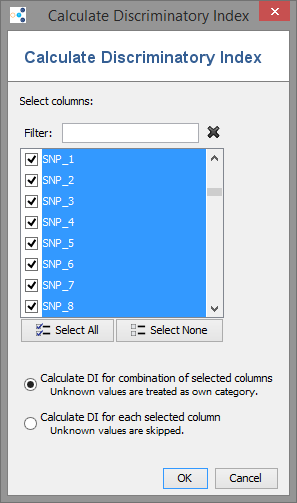
The discriminatory index for a typing method is the probability that two unrelated strains will be assigned to different types; equivalently, it is based on Simpson’s index of diversity. A higher value means better discrimination, with 1.0 meaning perfect separation of all strains and 0.0 meaning no discrimination at all. The Discriminatory Index is calculated with the following formula:
<math>D=1 - \frac{1}{N(N-1)} \sum^s_{j=1}n_j(n_j-1)</math>
where <math>N</math> is the total number of Samples, <math>s</math> is the total number of types described, and <math>n_j</math> is the number of Samples belonging to the <math>j</math>th type.
Unknown values can either be ignored or treated as an unknown category.
A 95% Confidence Interval can be calculated with the following formula:
<math>CI=[D-2 \sqrt(\sigma^2), D+2 \sqrt(\sigma^2)]</math>
with
<math>\sigma^2=\frac{4}{N} [\sum \pi_j^3 - (\sum \pi_j^2)^2 ]</math> and
<math>\pi_j = \frac{n_j}{N}</math>.
References
Simpson, E.H. Measurement of diversity. Nature 1949, 163:688 [Nature 163688a0]
Hunter, P.R., and Gaston, M.A. Numerical index of the discriminatory ability of typing systems: an application of Simpson’s index of diversity. J. Clin. Microbiol. 1988, 26: 2465–2466 [PubMed 3069867]
Grundmann, H., Hori, S., Tanner, G. Determining confidence intervals when measuring genetic diversity and the discriminatory abilities of typing methods for microorganisms. J. Clin. Microbiol. 2001, 39: 4190-4192 [PubMed 11682558]
FOR RESEARCH USE ONLY. NOT FOR USE IN CLINICAL DIAGNOSTIC PROCEDURES.